Komani Lake Ferry, Albania: What the Boat Ride Is Actually Like
Updated June 2026 — Marcus Webb has done the Komani Lake crossing four times in four years. Once in July (too busy), once in October (perfect), once with a mate from Leeds who almost missed the boat (his fault), and once on a research trip to Fierza at 6am in April when it was 4°C and absolutely worth it.
Komani Lake is a 34km reservoir carved into the Albanian Alps by the Drin River, and the ferry that crosses it from Koman to Fierza is the single best way to see northern Albania’s gorge landscape without trekking for three days. The boat leaves early — 8am or 9am depending on season — takes 2.5 to 3 hours, costs 600 ALL (about €5.50 / £4.60), and passes through some of the most dramatic river-gorge terrain in the Balkans. Most people do it as part of the Shkoder → Komani → Valbona route, which is the correct call. Here’s everything you need.
What Komani Lake Is (and Isn’t)
First, the honest reframe. Komani Lake is not a lake in the way you’d normally picture one. It’s a man-made reservoir — created in 1985 when the Koman hydroelectric dam was built across the Drin River gorge. The water backed up through the valley, swallowing the road and connecting a series of isolated mountain villages that previously had no reliable access to the outside world.
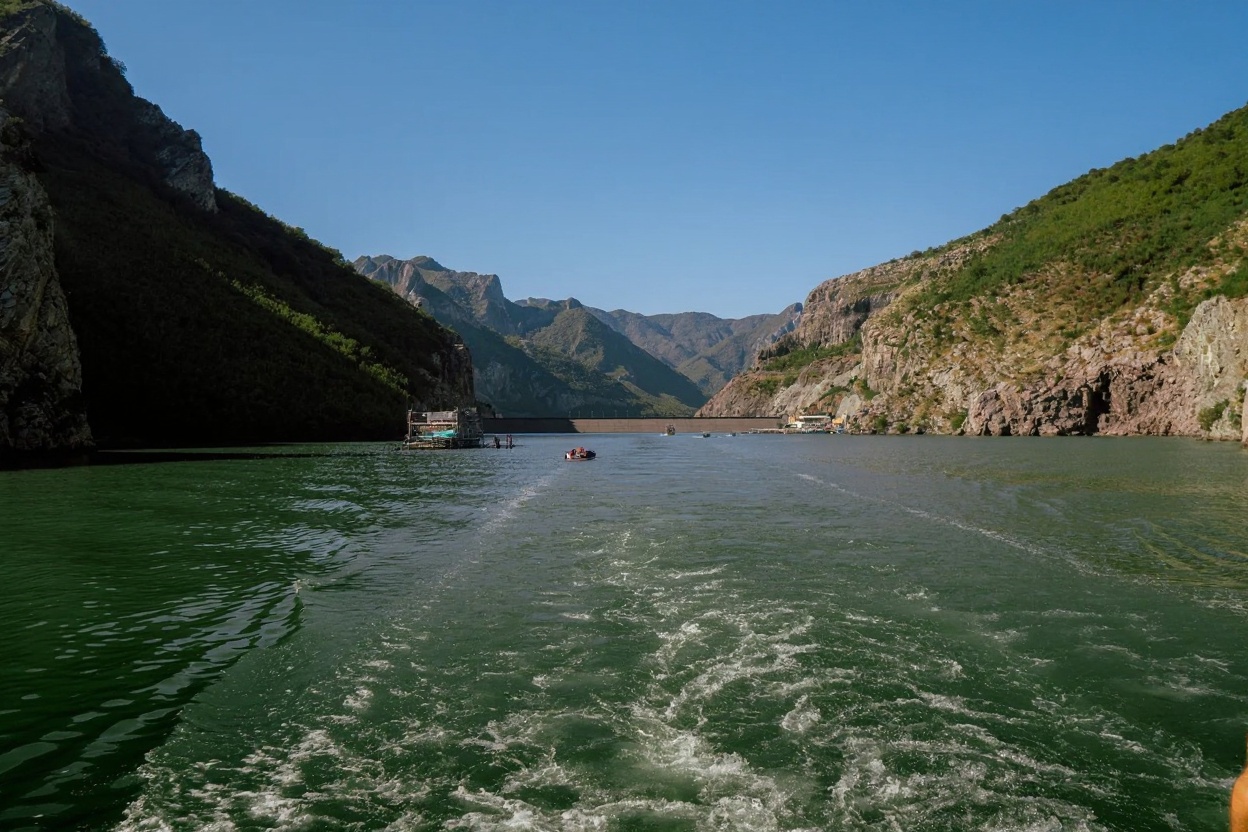
So what you’re crossing isn’t a serene natural lake. It’s a flooded mountain gorge. Which makes it, frankly, more interesting — not less.
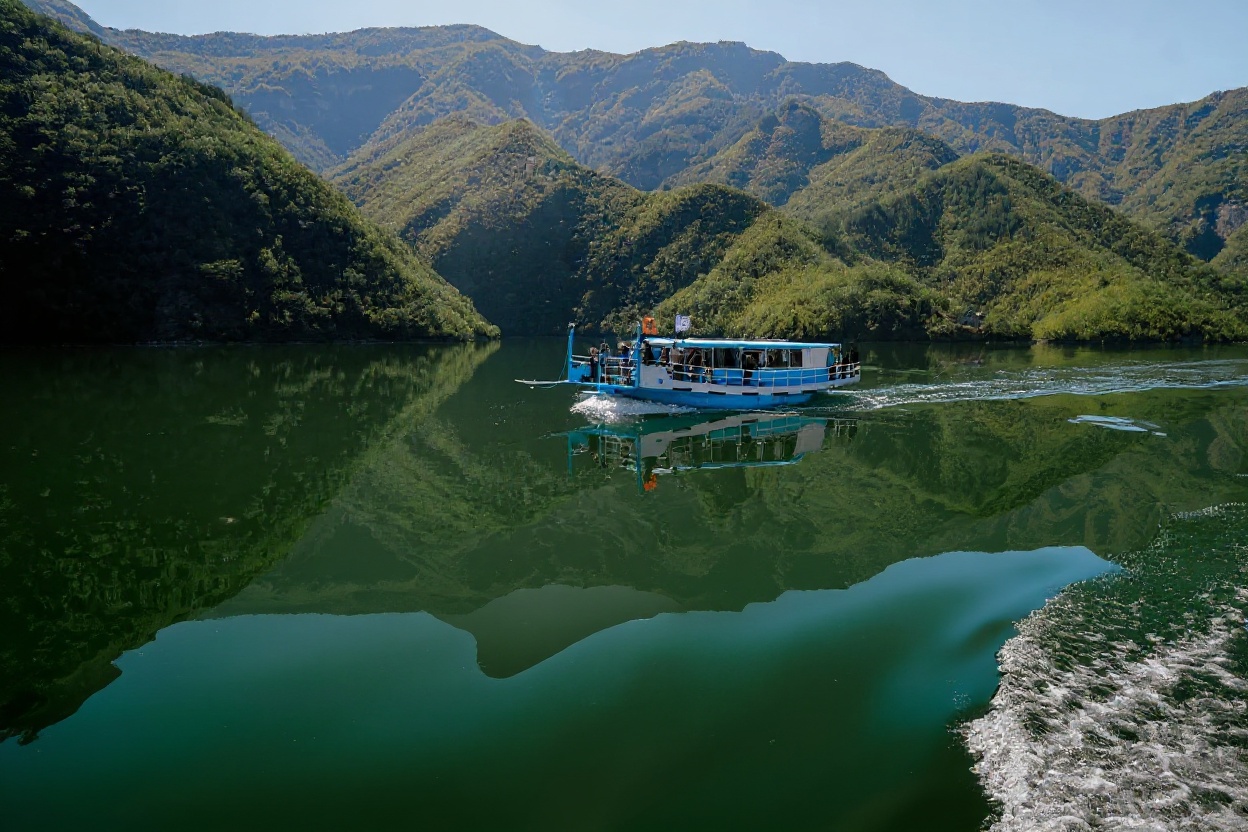
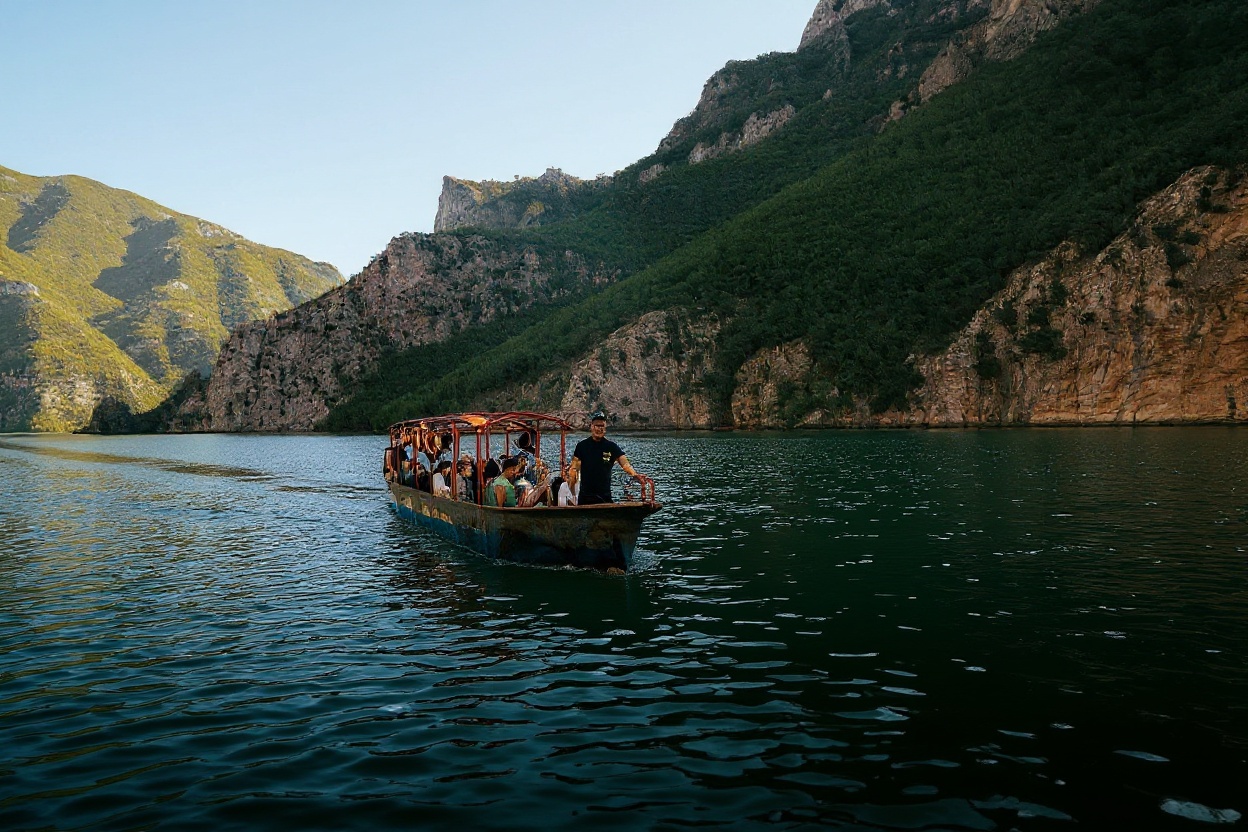
The cliffs on either side reach 300–400 metres. The water is the specific grey-green colour you get in deep glacial channels. The channel narrows in places to where you could almost shout to someone on the other bank. Isolated farmhouses cling to the rock at angles that make no structural sense. The ferry stops to drop off supplies at villages that have no other connection to the road network.
I took this crossing four times before I managed to actually describe it to anyone back home without sounding like I was exaggerating.
The Komani Lake Ferry: How It Works
There are two ferry operators running the crossing: Berisha Ferry (the larger, more established one) and a smaller local operator. Both run approximately the same route and the same times. Most travellers use Berisha.
Departure point: Koman dam — which is accessible by a specific road from Shkoder or from the Fushë-Arrëz direction. The dam itself has a small car park and a dock. There is no town, no café, and (in shoulder season) no one else around when you arrive. This is fine.
Departure time: 8am in high season (June–September). 9am in shoulder season (April–May, October). Check current times with Berisha via their Facebook page (search “Berisha Ferry Komani”) — they’re responsive and they post updates when weather affects the schedule.
Journey time: 2.5 to 3 hours from Koman dock to Fierza dock. The boat stops several times to deliver goods and passengers to lakeside villages, which is part of the appeal — watching a farmer load 20kg of something onto a wooden boat at an unmarked stone jetty is a very specific Albanian experience.
Cost: 600 ALL per person (about €5.50 / £4.60 / $6 USD). You pay on the boat. Cash only — have ALL ready.
Real Talk: The ferry does not wait. I know someone who missed it by four minutes and the driver watched them run down the dock and didn’t slow down. Get there 20 minutes early. If you’re relying on a morning transfer from Shkoder, build in serious buffer for the road to Koman — it takes longer than Google Maps says, especially in a minibus on those switchbacks.
| Komani Lake Ferry Quick Facts | |
|---|---|
| Departure | Koman dam dock, 8am (high season) / 9am (shoulder) |
| Arrival | Fierza dock, 2.5–3 hours later |
| Operator | Berisha Ferry (most reliable) + local operator |
| Cost | 600 ALL (~€5.50 / £4.60) per person — cash on boat |
| Car ferry | Yes — 2,000 ALL extra (~€18.50) for a car, limited space |
| Book in advance? | Not required for foot passengers. Strongly advised for cars in July/August. |
| From Shkoder to Koman | Minibus: 700 ALL (~€6.50) or taxi: 2,500–3,000 ALL (~€23–28) |
Getting to Koman Dam from Shkoder
Shkoder is the base city for this crossing — if you’re coming from Tirana, stop in Shkoder the night before. The drive from Tirana to Koman without stopping is possible but unpleasant: it’s 200km and about 3.5 hours including the mountain road section, meaning you’d need to leave before 5am to make the 8am ferry. Shkoder the night before makes everything easier.
From Shkoder, options:
Shared minibus (recommended): Berisha runs a minibus from the centre of Shkoder to Koman dam, timed to connect with the ferry. Departs around 6am from near Shkoder’s main roundabout (check the exact pickup point with Berisha when you book). Cost: 700 ALL (~€6.50 / £5.50). This is the correct option — the road to Koman has switchbacks that you do not want to drive yourself if you don’t know it.
Taxi: 2,500–3,000 ALL (€23–28) for the car. Negotiate in advance. Good option if there are three or four of you sharing.
Driving yourself: The road from Shkoder to Koman is paved but narrow in sections, with significant elevation changes. Fine in daylight, genuinely not recommended in the dark or in wet weather on unfamiliar tyres. If you’re taking your car on the ferry (it fits — limited spaces), plan the drive well.
What to Expect on the Ferry
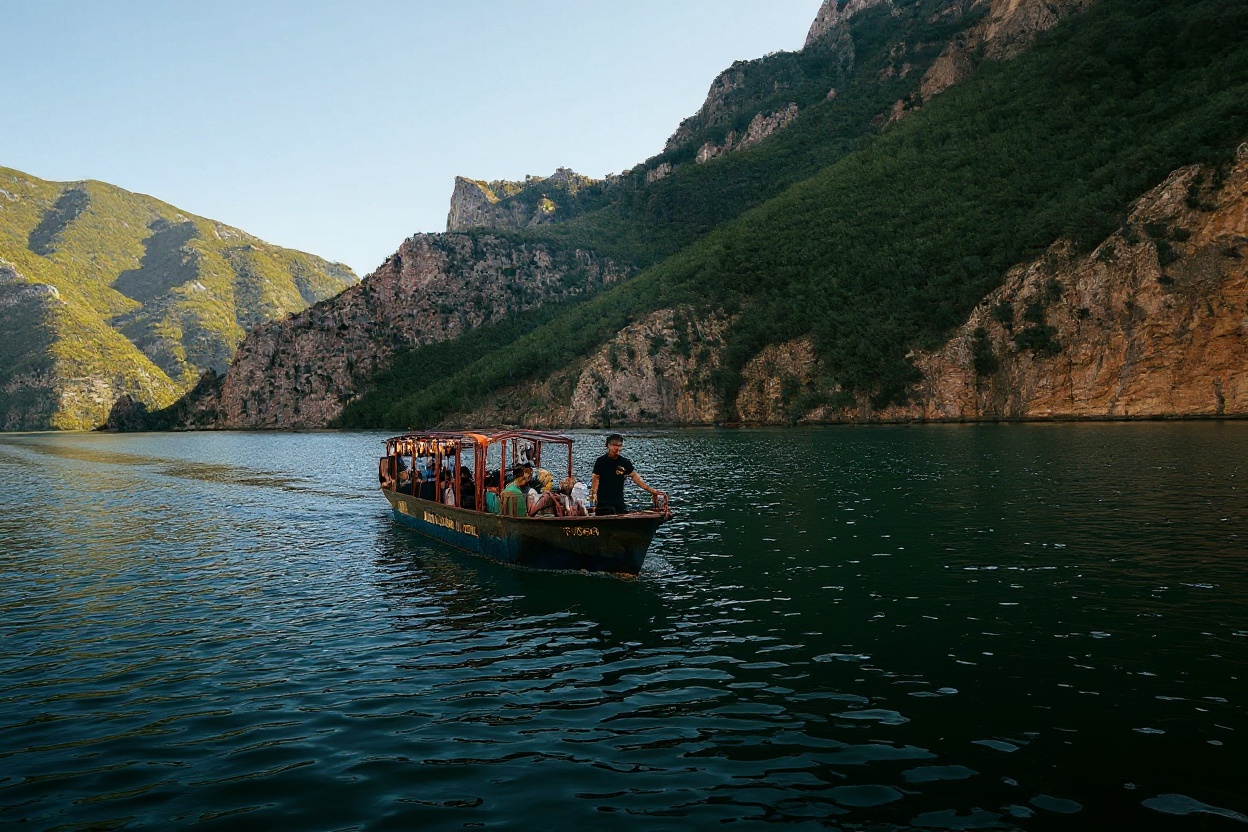
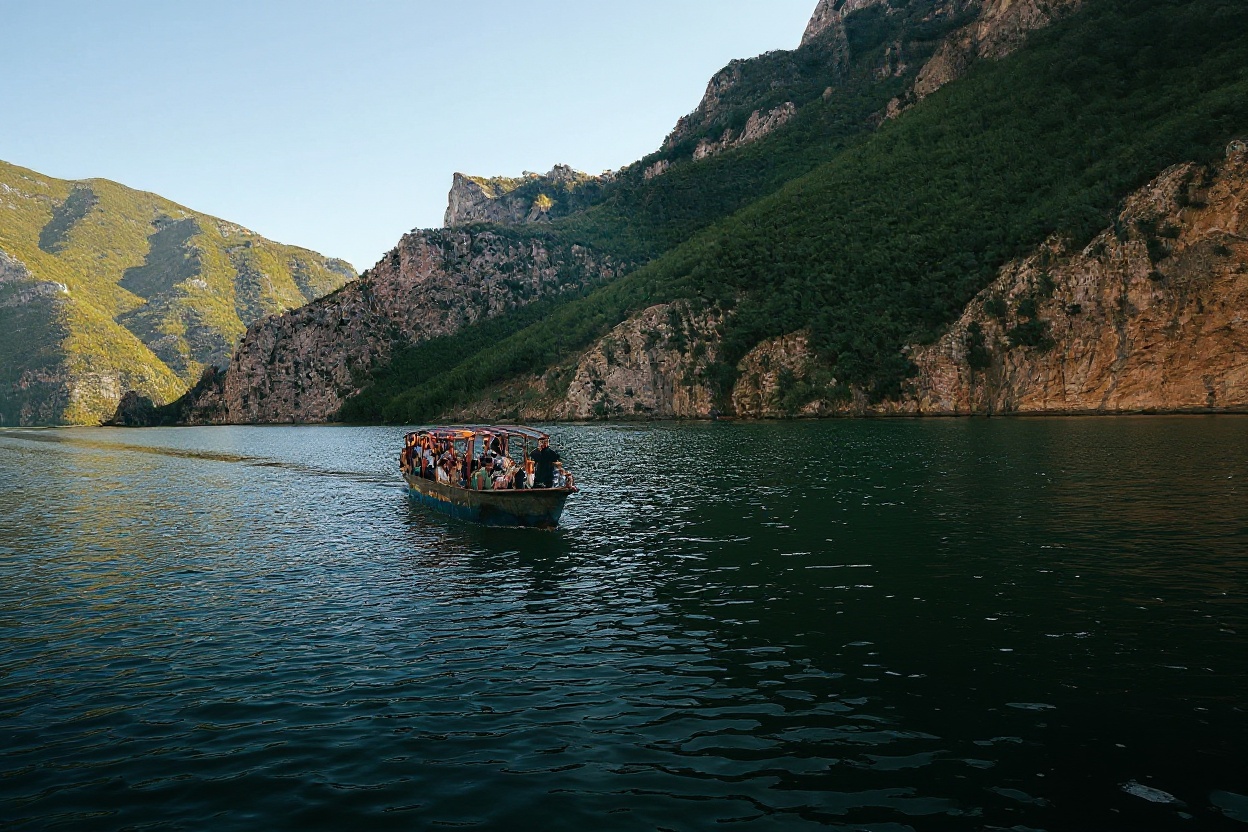
The Berisha ferry is a flat-bottomed boat with an open deck and a small covered cabin below. In summer, most people are on the deck — the cliffs slide past close enough to see individual rock strata. In April, I was in the cabin for the first hour, drinking coffee from a thermos I’d had the sense to bring, watching the mist burn off the gorge walls through the window.
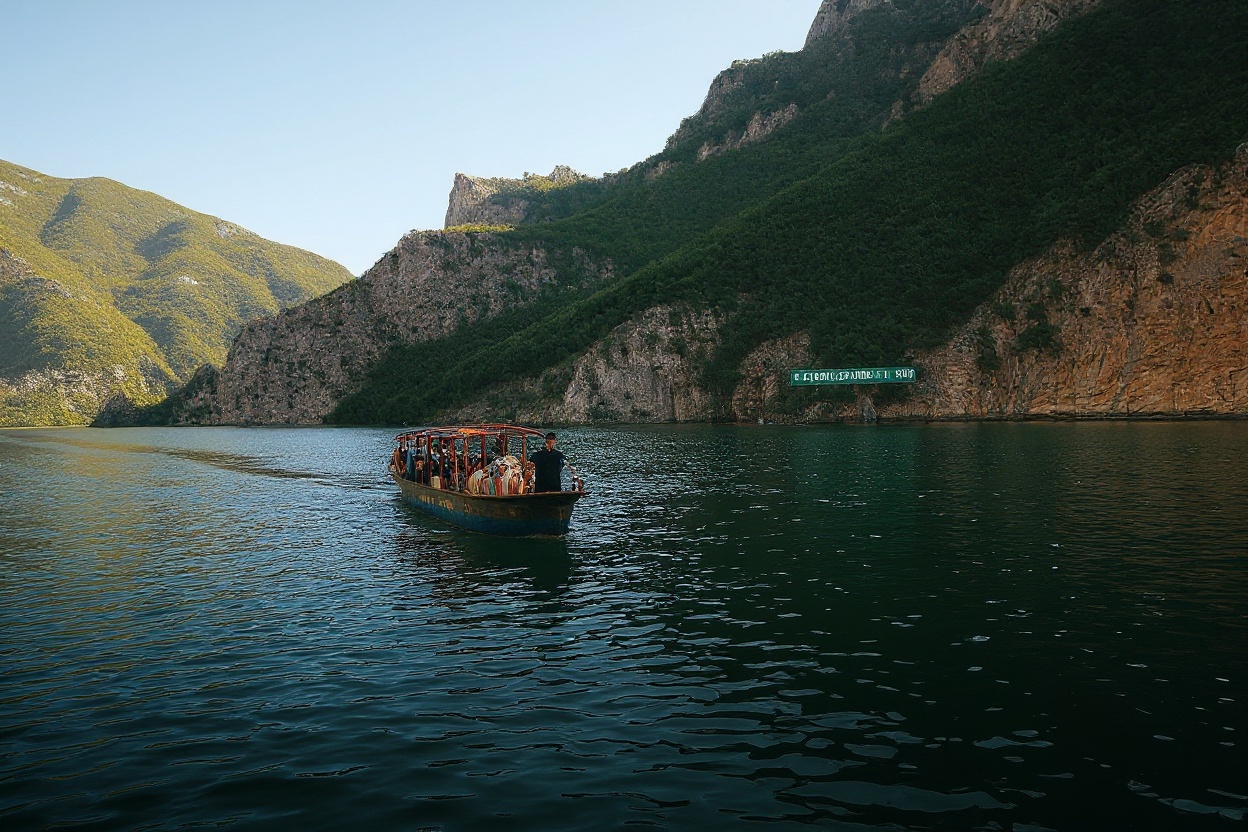
The crossing is genuinely quiet. Not performed quiet — actually quiet, except for the engine and occasional conversations in Albanian. People read. Look at the cliffs. Fall asleep. The Instagram version of this journey (drone shots, golden hour) doesn’t really capture what it’s like to sit on a working boat in a drowned gorge and just be in the place.
The stops at isolated villages are the highlight nobody mentions. The boat pulls up to a stone landing somewhere mid-gorge, and a family appears from a path in the cliff. There’s a handshake, some bags change hands, someone gets off. Then the boat moves on. These villages — some with three or four families, no road connection, no mobile signal — exist in a version of Albania that the coast doesn’t.
The specific blue-grey of the water at 8am, before the sun clears the gorge walls, is the image I keep coming back to. Not the cliffs. Not the villages. The colour of that water.
Komani to Valbona: The Full Route
Most people who do the Komani crossing do it as part of a longer northern Albania route — specifically, the classic Shkoder → Komani ferry → Valbona → Theth → Shkoder loop. This is the right approach. Doing Komani as a standalone day trip from Shkoder is fine; doing it as part of a multi-day mountain route is significantly better.
From Fierza (the far end of the ferry), a minibus to Bajram Curri departs when the ferry arrives — about 200 ALL (€1.80), 30 minutes. From Bajram Curri, onward transport to Valbona: shared furgon (300–400 ALL, €2.80–3.70) or taxi (1,500–2,000 ALL, €14–18 for the car). The valley is 25km from Bajram Curri — it’s either a 30-minute drive or a very long walk.
The Valbona–Theth trek (8–10 hours, 16km over a 1,800m pass) is a full separate guide. But the route makes the Komani crossing feel like a natural beginning — you arrive in Fierza, you’re already in the mountains, you go deeper.
MARCUS’S PICK: One night in Valbona after the Komani crossing. The Rilindja guest house (run by Catherine Bohne, American, been there 20+ years — you’ll find her) is the place. Wake up, look at the mountains. Do the pass to Theth the next morning if you’re fit. If not, sit in the valley for a day. Both are correct.
Best Time to Go: Honest Assessment by Season
July–August: The ferry is full — up to 80 people, some tour groups. Still worth it, but the quiet-boat experience is different when 40 Italians are taking photos simultaneously. Booking the connecting minibus from Shkoder becomes important rather than optional. Hot on the open deck.
June / September: Correct. Good weather, manageable crowds, accommodation in Valbona available. June means full greenery on the cliffs. September means the first yellow-orange on the beech trees at elevation.
May / October: Excellent if you can handle the variable weather. Fewer tourists, dramatically more atmosphere. May: wildflowers on the gorge walls. October: the beech forest is properly on fire with colour. The ferry runs less frequently — confirm schedule in advance.
November–April: The ferry typically stops running in November (weather dependent) and resumes around April. I’ve done the April crossing — 4°C, mist, no other tourists, a local family returning from Shkoder market with a live chicken in a bag. Absolutely memorable. Not for everyone.
The 3-Day Shkoder → Komani → Valbona → Theth Route
This is the route. If you’re in northern Albania and asking what to do with three days, this is the answer — no equivocation.
Day 1: Shkoder → Komani ferry → Valbona
Berisha minibus from Shkoder at 6am, ferry at 8am, Fierza by 10:30–11am. Minibus from Fierza dock to Bajram Curri (30 min, 200 ALL). Furgon or shared taxi to Valbona — the valley is 25km, takes 30–40 minutes on a road that starts sealed and ends in a kind of optimism. Arrive in Valbona Valley by 1pm. Afternoon: walk to the river, do nothing particularly productive. Evening: dinner at the guest house — they’ll cook whatever they’re cooking and you’ll eat it. Sleep well at 1,000m altitude.
Day 2: Valbona Valley → Theth (the pass)
The Valbona–Theth hike is 16km over a mountain pass at 1,800m. Starts at the Valbona guest house cluster, climbs steadily through beech forest, opens out onto high alpine meadow, crosses the Valbona Pass, drops steeply into the Theth valley on a path that is good but requires concentration when wet. Total time: 6–9 hours depending on pace and stops. Take water, food, a layer, and a rain jacket — the pass generates its own weather. Arrive in Theth by mid-afternoon. The Stone Kulla guest house near the waterfall is the place.
Day 3: Theth → Shkoder
Morning: the Theth waterfall (30 minutes from the village centre, free). If you have time: the Grunas Canyon trail (2 hours return). Furgon from Theth to Shkoder departs around 7am — this is the departure that people miss, because it’s early and the driver doesn’t announce it loudly. Confirm the time with your guest house the night before. Cost: 1,000–1,200 ALL (€9–11) per person. Arrive in Shkoder by 10:30am. From Shkoder, Tirana is 3 hours by bus (500 ALL).
The full loop — Shkoder → ferry → Valbona → Theth → Shkoder — is 3 days, requires two nights of guest house accommodation (€20–30 per person per night with dinner included, typically), and costs approximately €60–80 all in for transport and accommodation. This is the correct value-for-experience calculation for northern Albania. For context: a budget day in Croatia costs roughly the same as this entire three-day loop, including the ferry crossing, two dinners cooked by mountain families, and a pass hike that would cost €80 as a guided tour anywhere in Western Europe.
Where to Stay: Shkoder and the Valley
Shkoder (night before the ferry): Tradita Guest House (Rruga Kole Idromeno) — a converted Ottoman house in the old city, doubles from €35–45 including breakfast. The courtyard is better than it looks from the street. Alternatively: Rozafa Hostel for budget travellers (dorm beds €10–12, private rooms €25–30). Both are walkable from where Berisha’s minibus picks up.
Do not stay in a random hotel on the outskirts. The point of Shkoder is the old city — the Bazaar district, the Rozafa Castle on the hill above the lake, the afternoon light on the Buna River. Stay somewhere inside that.
Valbona Valley: Rilindja Guest House (run by Catherine Bohne) is the main name and for good reason — excellent dinner, reliable information about trail conditions, and rooms that are simple but clean at €25–35 per person with dinner. Book ahead in June–August; shoulder season you can usually arrive and find space. Several other family guest houses in the valley offer similar pricing — Flora Guest House and Gjoni Guest House both have good reputations.
Theth: Stone Kulla is near the waterfall and charges €20–30 per person with dinner. Bujtina e Kolë has been recommended by multiple people I trust. Theth village has ten or so guest houses — the village is small, they’re all visible, and the ones nearest the church and the waterfall path are the best situated.
Useful Albanian Phrases for the Ferry Route
You don’t need Albanian to do this trip — the ferry and minibus connections work on gesture and pointing as well as anything. But a few words go a long way with the ferry staff and guest house owners in the valley, who don’t all have English. The further north you go in Albania, the more this matters: Shkoder has English-speaking younger staff at most guest houses; Valbona and Theth are family-run operations where a phrase or two earns a noticeably warmer reception than none.
Sa kushton? (say: SAH koosh-TON) — How much? The single most useful phrase in Albania.
Ku shkon anija? (say: KOO shkon AH-nee-ah) — Where does the boat go? Useful at the dock if you’re confused about which boat is which.
Njё vend për Fierza, ju lutem (say: NYUH vend pehr FYEHR-za, yoo LOO-tem) — One place to Fierza, please. For buying the ticket.
Faleminderit (say: fa-leh-meen-DEH-reet) — Thank you. Use it constantly. Albanians notice.
Besnik from the qaxe on Rruga Sami Frashëri in Tirana taught me most of my Albanian, and the first thing he said was: learn faleminderit before anything else. He was right.
The Mistake I Made at Komani
First time I did this crossing, I arranged my own transfer to Koman rather than using Berisha’s minibus. Found a taxi in Shkoder the evening before, agreed a price, set a 5:45am alarm.
The taxi driver was 25 minutes late. On mountain roads with switchbacks I didn’t know, doing the time calculation in my head. We arrived at Koman dock with seven minutes to spare. The ferry was already loading cars. I ran down the ramp with my bag banging against my hip.
The trip was brilliant. The near-miss was entirely avoidable. Use Berisha’s minibus. It exists specifically to make sure people are at the dock on time. The 700 ALL is not the point — the margin of error is.
- Do I need to book the Komani Lake ferry in advance?
- Foot passengers don’t need advance booking — turn up and pay on the boat (600 ALL, cash). If you’re bringing a car, book with Berisha in advance, especially July–August when car spaces fill up. For the connecting minibus from Shkoder, messaging Berisha on Facebook the day before is wise in high season — they’ll confirm space.
- Can I do Komani Lake as a day trip from Shkoder?
- Technically yes — the return ferry runs from Fierza back to Koman in the afternoon (times vary by season). But it’s a 5–6 hour round trip on the water plus the road from Shkoder. Most people who do this wish they’d stayed overnight in Valbona instead. If you have only one day, the crossing is still worth doing. If you have two days, go to Valbona.
- Is the Komani Lake ferry safe?
- Yes. The ferry has run this route for decades. The boat is basic but solid, and the crossing is through calm reservoir water (no currents, no tides). The main safety consideration is the road to Koman — mountain switchbacks on a narrow road that requires attention, especially in wet conditions. Sit on the left side of the boat heading toward Fierza for the best cliff views.
- What should I bring on the Komani Lake ferry?
- Snacks and water — there’s no food service on the boat. A jacket even in summer (the gorge channels cold air in the morning). Cash in ALL for the ferry and onward transport. Camera. Something to read for the quieter middle section. In shoulder season, add a warm layer and rain cover for your bag.
- How does Komani Lake connect to Valbona Valley?
- From Fierza (ferry end point), a minibus to Bajram Curri departs when the ferry arrives — 200 ALL, 30 minutes. From Bajram Curri, shared furgon or taxi to Valbona Valley: 300–2,000 ALL depending on whether you share. The whole Shkoder → Komani ferry → Valbona journey takes most of a day, which is why an overnight in Valbona makes sense.
And look — if you’ve done the crossing and you’re waiting at Fierza for the onward furgon to Bajram Curri, find a shaded spot and eat whatever you brought. The dock at Fierza has a small tea stand occasionally but nothing reliable. This is the gap between the ferry and the mountains, and it’s worth thirty minutes of quiet before the road north.
Right. That’s everything you need for the Komani crossing. Get the Berisha minibus from Shkoder, be at the dock early, sit on the left side, bring your own coffee if you care about mornings. The rest works itself out. Questions in the comments — I check them most days.